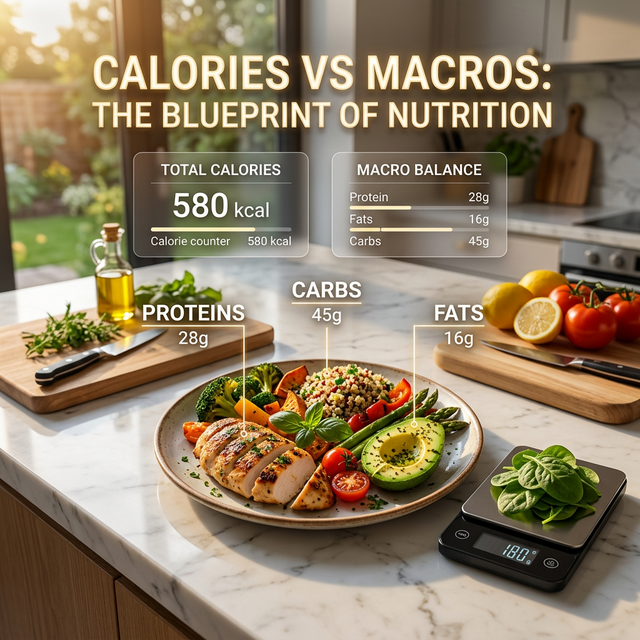
"A calorie is a calorie." For decades, this phrase has been the foundational dogma of the weight loss industry. Strictly speaking, the First Law of Thermodynamics dictates that if you eat fewer calories than you burn, you will lose weight. But as nutritional science advances, we realize that while calorie counting dictates weight change, macronutrient tracking dictates body composition change.
If you've ever lost weight but felt sluggish, lost muscle mass, or felt constantly hungry, you likely focused purely on calories while ignoring your macros.
The Problem With the "1,500 Calorie Diet"
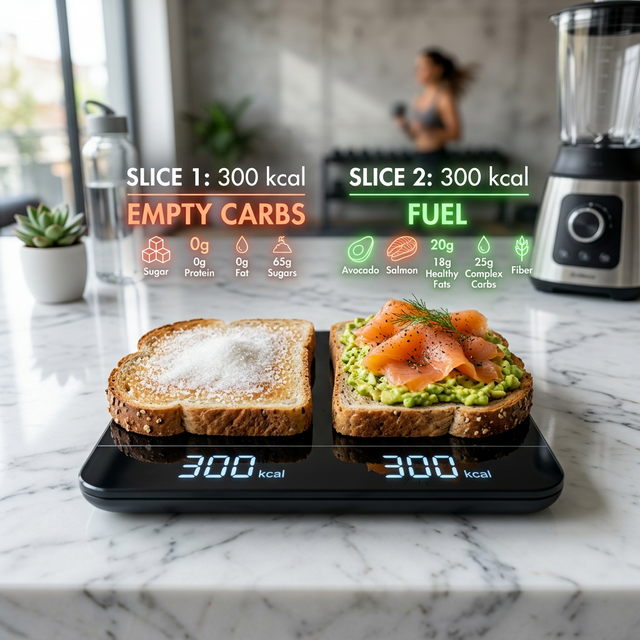
Imagine two different diets, both exactly 1,500 calories per day:
- Diet A: 1,500 calories composed entirely of donuts and sugary lattes.
- Diet B: 1,500 calories composed of lean proteins, complex carbohydrates, and healthy fats.
Will you lose weight on both? If your maintenance level is 2,000 calories, yes. But the quality of that weight loss will be drastically different.
Understanding the Big Three
Your food is made up of three primary macronutrients, each playing a uniquely critical role in your body's endocrine (hormonal) and metabolic systems.
1. Protein (4 calories per gram)
Protein is the building block of muscle tissue. During a caloric deficit, your body looks for energy. If you aren't eating enough protein, your body will break down your own muscle tissue for fuel before it burns stubborn body fat. Furthermore, protein has the highest Thermic Effect of Food (TEF)—meaning your body burns up to 30% of the calories in protein just trying to digest it.
2. Fats (9 calories per gram)
Fats are often demonized due to their high caloric density, but they are essential for regulating hormones. Low-fat diets often result in plummeting testosterone in men and hormonal imbalances in women. Fats also slow digestion, keeping you satiated for longer.
3. Carbohydrates (4 calories per gram)
Carbs are your body's preferred energy source, especially for high-intensity exercise. While "low carb" diets like Keto are popular for rapid initial water-weight loss, carbs are crucial for performance. The key is prioritizing complex, high-fiber carbohydrates over simple sugars.
The "Flexible Dieting" Approach (IIFYM)
This scientific understanding led to the rise of "If It Fits Your Macros" (IIFYM). Instead of classifying foods as "good" or "bad," flexible dieting focuses on hitting specific daily targets for protein, fat, and carbs. This allows for massive dietary freedom; as long as you hit your protein goals, you can have a slice of pizza without ruining your progress.
Let AI Track Your Macros
Manually weighing your chicken breast to hit your protein goal is exhausting. Take a photo, and Calozen gives you the exact macro breakdown in milliseconds.
Get Calozen.comConclusion: Graduate From Calories
Counting calories is the elementary school of nutrition. It teaches you the basics of portion control. Tracking macros is the university level. It teaches you how to fuel your body for optimal body composition, hormonal health, and athletic performance.
Stop starving yourself on arbitrary low-calorie diets. Start feeding your body the macros it actually needs.